Monday, 3 February 2014

Closed App Store or open Android Market? Both, please.


Apple and Android logos


Apple and Google are at war over whose system of accepting apps is better. Here's why they should offer both.

There is little doubt that one of the biggest changes in technology over the last ten years is the adoption of the smartphone. And well as changing the habits of mobile phone users, it's meant a lot of changes to computers in general. Not all have been good - it has propagated some ridiculous patent lawsuits, and it's encourages the rise of some highly dubious "freemium" games - but one of the best things it's brought, in my opinion, in my opinion, is the concept of the app store.

In the Linux world, the idea of the app store is old hat. For decades, most Linux distros have been orgnaised into packages. Some are integral to the system, such as the kernel and desktop, some are standard packages such as Libreoffice, and some are extra packages that users add to their system. To add an extra packages, you simply go to the Add/Remove programme, click on what you want, and Linux downloads and installs it for you. There are a lot of advantages to this method: it automatically installs any other software you need to run this program, everything is automatically updated, and if you ever want to install the program, Linux does it for you rather than relying on a dubious uninstallation package that came with the program. Although most software installed this way is free, it has been used for paid apps too.

So, in theory, it is welcome that this practice has been adopted on smartphones. In practice, however, things are more complicated. There are two big changes between Linux and smartphones. Firstly, it's opened this approach up from a mainly tech-savy small group to the masses of smartphone owners. Secondly, this method of installing software has suddenly become a lucrative way of earning money. As a result, there are now thousands of app writers all jostling for status in a highly competitive market. And this is where Apple and Google have heavily differed in their answer to this challenge.

Monday, 9 September 2013

The big bang theory

If you look beyond the political point-scoring over the latest debacle on Universal Credit, the real lesson is that the "big bang" approach to IT projects rarely pays off.

A completely inaccuarate depiction of the Big Bang.
Also not a good approach to most software projects.
Well, I hate to say I told you so, but ... I told you so. Just under a year ago, I idly speculated that the next big story about an IT cock-up might be the upcoming Universal Credits system. I won't go over the whole thing in detail, but it boiled down to two concerns: firstly, I was sceptical over whether the intended launch of October 2013 was realistic; and secondly, I know from my experience of ID cards that there is a culture in the civil service of making promises that cannot be delivered. And what do I find yesterday? Oh dear, oh dear, oh dear.

Now, before I jump on any bandwagons, it's helpful to put this in a bit of context. Firstly, the National Audit Office is notorious for nit-picking (as is the Public Accounts Committee), and their supposedly damning reports are often little more than minor points blown out of proportion by the press. Secondly, benefit reform is a hugely controversial issue and a lot of criticism (and defence) of this IT project will be down to ideological stance on benefits rather than whether the product does the job. (For the record, I think the principles of Universal Credit - that work should always pay and simplification of a bloated complex system - are a good idea, but there's valid points over using the reform as a smokescreen for cuts.) Nevertheless, it looks like there's more to this one than political hype. The October launch is now just six pilot sites, which is a common Civil Service method of back-pedalling in a way they can claim they "met" the deadline.

So what's gone wrong? There is a good summary of reported mistakes on BBC news, and the thing that struck me the most about this is how similar these mistakes are to the mistakes made with ID cards. Comparing what's happening now to what happened with ID cards, I can tell you the following:

Wednesday, 31 July 2013

Bring on the naked laptops

If we’re serious about using technology to empower users, people should have the choice to buy a laptop, tablet or smartphone without the software.


This is my new laptop. Observant readers will notice that this is a Chromebook running Ubuntu on it. As Linux fans know, Ubuntu and most other Linux distributions can be legally downloaded for free and installed on any computer. The only question is what computer you choose. For me, a Chromebook seemed like a good bet: they are cheap low-spec laptops, probably incapable of running Windows 7, but Ubuntu is a resource-light operating system and I use my desktop for anything resource-intensive. Chrome OS is heavily geared towards users of Google services, like GMail and Google Docs, but I’m installing my own software so that doesn’t matter. So, let’s buy a Chromebook and install Ubuntu. Simple, huh? Simple?

Hah, I wish! You have no idea how much blood, sweat and tears I’ve been through to get to what you can see in that photo. It all boils down to this thing on Chromebooks called secure boot (aka verified boot). Oh boy. This is something that, in theory, is meant to protect you from hackers up to no good – I have used the words “in theory” for a reason, but I’ll come back to that later. As far as Chromebooks are concerned, there is a way of switching off secure boot by going into “developer mode” (which isn’t advertised widely, but if the intention is to prevent people fiddling with settings who don’t know what they’re doing, that’s fair enough). Unfortunately, even in this mode, you still can’t boot from a CD/USB drive, which is the normal way of installing an operating system. Never mind, there’s an Ubuntu derivative out there called Chrubuntu, specially designed to be downloaded and installed from a command prompt in Chrome OS. Okay, that doesn’t sound too bad.


Monday, 25 March 2013

Time to wise up to Freemium

The recent case of a £1,700 Zombies vs Ninja bill should be a wake-up call for how ruthlessly children are being used as cash cows.

“That will be £699.99, please.”

For all the criticisms I have of Apple, one of the things they got right was the App store. They weren’t first people to use this model (Linux distros had already used this approach for years), but they did pioneer mainstream adoption. This has brought a lot of benefits: software installed through repositories such as App Stores easily remains up to date, you don’t have to search on the internet to find the program you’re after (and therefore little danger of accidentally installing a spiked program masquerading as the one you’re after), and it’s easy to remove anything you don’t like (as opposed to hoping the program came with a working uninstall mechanism). It’s also opened up the market on paid apps beyond the big players, and pushed down prices; no more will we be forking out £29.99 for very basic games. On the whole this has been a major step forwards.

Not everything about it has been welcomed. There are quite a few iffy questions about Apple and Windows 8’s over-zealous vetting policies, which I’ve discussed before. But lately I’ve seen a new breed of programs coming to App stores which I think needs questioning. These are known as “Freemium”, and these apps, usually games, are free to download. But if you want to advance in the game, you have to pay real money to receive in-game power-ups. Let’s make this clear: it is nothing like the old model of a free demo version or a paid full-version – they make their money from customers who pay for upgrades again, and again, and again. Freemium advocates might argue that if you want to be a football champion, you have to spend money on a decent kit and training, but I don’t agree. This is cyber-land, where “training” and “kit” is merely changing a few ones and zeros in your favour, and unlike real training and kit this costs nothing to make. I would rather liken this to an owner of a cricket pitch charging you extra for bowling overarm.


Wednesday, 27 February 2013

Who needs 1984 when we’ve got Foursquare?

Online snooping is getting worrying – but if we want to stop this, we must ask some fundamental questions about social media.

The next poster in the series says "Facebook is privacy"

When George Orwell created Nineteen Eighty-Four and Big Brother in 1948, he could scarcely have imagined the future. Not so much the nightmarish vision of the Ministry of Truth, Ministry of Plenty, Ministry of Peace and Ministry of Love, but two things he would never have guessed. Firstly, the emergence of god-awful reality TV show Big Brother (and all the other god-awful reality TV programmes it spawned), and secondly, a load of persecution complex-ridden Middle Englanders who says “It’s just like 1984” every time they get a speeding fine. I suppose some bits bear resemblance to the book, but that tends to be things like petty council officials invoking anti-terrorist laws over littering. All in all, it’s a bit of a damp squib.

But fear not, Mr. Orwell, all is not lost. Recently we have seen the arrival of a new program called RIOT (Rapid Information Overlay Technology). This little device uses information from social networks to track the movements of individual people. It is suggested this could be used as ways of monitoring people who are about to commit a crime – cue analogies to Precrime in Minority Report – but just like its ficticious counterpart, there are serious questions of how reliable this would actually be. Certainly there’s not much enthusiasm from the Police. Which makes me think the key market might be employers. Like a retail manager who wants to know if his staff are shopping at competitors. Or a civil servant checking which pesky underlings attend opposition party meetings in the run-up to an election. This could be fantastic news – if you are a control freak with lots of money and power.

Tuesday, 29 January 2013

A harsh lesson for Facebook

As expectations for a free internet increase, more novel ways have to be found to make money. Instagram is a prime example of how not to do it.
“Hello John. You only did six Facebook Status Updates yesterday. Why don’t you buy
the new iThing plus max supreme, with new Facebook infinity plugin included?”

There’s a famous scene from the Stephen Spielberg classic Minority Report depicting a possible future of advertising. In the film, whenever our hero John Anderton enters shopping centre, the nearest advertising billboard scans his irises and says “You, John Anderton, need a holiday / designer jacket / ticket to the Superbowl.” (And when he gets a new pair of eyes on the black market, the adverts change to “You, Mr. Yakamoto, need a holiday / designer jacket / ticket to the Superbowl.”)

Like most science fiction films, it sought to portray an uncomfortable vision of the future, in this case one with scant disregard for civil rights or privacy. However, it appears that the advertising industry completely missed the point and thought Mr. Spielberg was portraying a rosy future where hard-working businesses can sell more products to consumers through a “relevant adverting experience”. At least, this would explain the logic behind those internet adverts of “57-year-old [Insert location you are accessing internet from] Mom looks 27 – click here to discover her secret”. It would also explain why, when you look at one website, the adverts of that product keep following you to other sites – an action I find comparable to sales reps from Boots following you into Debenhams and Costa to pester you into buying the shampoo you were vaguely browsing.

They haven’t quite reached the technology needed to do full Minority Report -style advertising, but recently a photo-sharing site decided it would join in the fun. Yes, following its recent acquisition by Facebook, Instagram helpfully informed its customers, somewhere in its new terms and conditions, stating that in one month’s time they’d have the right to use your photos for any advertising they want One problem: in most cases, it’s not just the consent of the uploader you need: you also need the consent of the photographer (who is not necessarily the uploader) and for adverts you really need the consent of the people in the photos too. So really the only practical legal way they could use this is to use people’s photos as personalised adverts directed at them. Not sure what they had in mind – maybe “If you liked these hills, you’ll love the hills in Bratislakislavia which you can now reach with cheap flights from us. Click Here.” Anyway, we’ll never find out what their plans were because a massive backlash forced them into a U-turn.


Tuesday, 27 November 2012

What is going on with Google’s takedown requests?

Iggle Piggle: The new boss of the Pirate Bay?

I know I promised to take a break from Microsoft blog posts, but here’s a third one in a row. Not Windows 8 this time; it's about how Microsoft has got itself in the news for the wrong reasons. It’s been spotted that Microsoft has been sending automated copyright infringement notices to Google claiming that its copyrighted material is being infringed by sites such as, err … the BBC and its well-known hotbed of online piracy, CBeebies. The BBC was unaffected as it’s on a Google whitelist, but other sites weren’t so lucky, including perfectly reputable sites such as AMC Theatres and RealClearPolitics.

First of all, embarrassing though this is for Microsoft, it’s not fair to single them out. Their only crime is getting caught. The majority of copyright enforcement comes from the big film and record labels. As I’ve previously written, wanting to protect their material is reasonable, but their record of heavy-handedness isn’t. Although Microsoft has been criticised for collusion with the record companies, on this issue of dodgy automated takedown requests, I imagine the record companies are doing the same, if not more.


Wednesday, 31 October 2012

Lessons from the Narwhal

There is a lot at stake with the new user interface in Windows 8. Ubuntu’s experience from 2011 gives us clues for how this might work out.

Screenshots of Unity with critical remarks
Brace yourself Microsoft. It's your turn now.

With a new Windows version coming out, 8 is of course dominating the tech blogs. I haven’t looked much myself, but I’m assuming there’s gushing praise from Microsoft fanboys and scathing remarks from the hardcore Mac and Linux fans. I really have no appetite for a string of blog posts on one product myself, but having had a look at Windows 8, there’s now one extra thing that’s grabbed my attention other than the Windows Store, and that’s the Metro Interface (it’s now called the “Modern UI” due to a copyright row, but everyone’s still calling it Metro). I promise to move on to something else next time.

This new interface has grabbed a lot of attention, and not all of it’s good. Microsoft’s incentive is to make Windows 8 more friendly to tablet users where they desperately want to compete with Apple and Android, but they risk alienating their desktop customers. I have now tried out their interface and I can confirm it’s a right pain in the bum to operate with a mouse compared to the Start menu it replaced. I can see this being good for touchscreens, but there’s no sign touchscreens are going to replace keyboard, mouse and monitor in the office. Usability is a major issue for mass consumer software, and from the sound of some commentators you’d think this was Windows suicide.

Friday, 19 October 2012

Cross-platform is the way to go

AMD will shortly be enabling Windows 8 users to run Android apps. I would advise Microsoft to welcome and support this.

Mr Ballmer, surely you won't deprive
your loyal customers of this?

Last year I wrote a blog article on “The Ghost of Vistas Past”, outlining how high important it was to Microsoft that Windows 8 is a success (along with the mistakes from Windows Vista that overshadows the reputation of all future releases). Well, we’re now approaching the release date and I’ve been looking at the pre-release version. Have to say, there have been a lot of Windows 8-bashing comments, but it’s hard to tell whether this is just the new tablet-optimised interface they’re getting used to or something more. At the moment, this could still be anything from a revolutionary ground-breaker to a Vista Mark II. But I’m going to make Microsoft a helpful suggestion regarding their controversial app store.

Firstly, an app store is a good idea. Linux distros were doing this years before there was the iPhone, when it was called “package management”. It’s good because instead of a mish-mash of programs from installation CDs or the internet, there’s a central database which takes care of all installation and updating. And as your computer keeps track of which packages installed which files, if you want to uninstall anything, you can do it properly, instead relying on unreliable uninstallation files that came with the program you don’t want. So far, so good.


Friday, 5 October 2012

Politics versus Plan B

There is no more important place to get IT projects right than central government. Unfortunately, internal politics encourages the opposite.


This is a visual metaphor, with little or no relevance to the actual article.

Who’d be a prime minister? On one day it’s all “We Love You Dave/Gordon/Tony”, then the moment you’re under 35% in the opinion polls it’s a catalogue of everything your government’s doing wrong. This year it’s been the granny tax, pastygate, the petrol non-strike, G4S and the West Coast rail franchise to name a few. All that’s missing is a good old IT shambles. After all, the last government kept us busy with the lost child benefit discs and the ill-fated NHS system. Well, for all you restless journalists itching for a story, I recommend you keep an eye on the upcoming Universal Credit benefit system.

In case you’re not following UK politics on an hourly basis, Universal credit is a plan to merge a number of key benefits such as jobseekers’ allowance and tax credits into a single system. Benefits is a controversial issue right now, but this is a software testing blog, and the issue of interest is that this is all dependent on a new IT system being developed. Now, before I go any further, I must stress I don’t know anything about how this project is going. For all I know, it could be all going swimmingly. But what if it isn’t? There doesn’t seem to be any kind of Plan B ready if the project goes behind schedule. And if this happens, it won’t be the first, because I worked on the last IT project where that happened.

Which IT project, I hear you ask? Well, please don’t be too harsh, it wasn’t my idea, they made me do it, but – I did software testing for ID cards. Yes, those ID cards. Remember them?

Friday, 14 September 2012

Where's H. G. Wells when you need him?

Is advertising really legalised lying? In cyberspace, it seems, the answer is still yes.

Bad and wrong. But is this coming to YouTube?
Okay, I’m back. Sorry about my long period of absence from this blog. Much as I enjoy a blog on software testing, actual software testing got in the way and I’ve been super-busy for the best part of two months. But this work has finally come to a close so I can now get back to this. And the thing that I’ve wanted to get off my chest for the last two months is a pet hate to many people: internet advertising. Yes, I can hear you all now going "Oh God, I hate those things".

I’ll start with an obvious defence: if we want an internet, we need ads. Some websites, such as this one, are done by people in their spare time (which can be sporadic, as this one has just shown), whilst others, such as BBC News, are funded by other means. But for many sites, somebody has to be paid to create the content, and the only source of revenue is from the website itself. Even ad-free sites can depend on adverts. This blog, for instance, has no adverts, and I want to keep it that way, but I’ll admit that Blogger would never have developed the blogging tools and hosted the blog for free without the cut Google gets from adverts on other blogs they host. There are some interesting suggestions for online micro-payments as an alternative to ads or subscriptions, but there is little interest in making this a reality. Like it or not, adverts are just as much a part of the internet as they are to ITV.

Friday, 29 June 2012

So what went wrong at Natwest?


A lot of questions need to be asked over RBS’s computer problems – but if we want to stop this happening again, we need to listen to the answers.

An easy answer. But not a useful one.
So there we have it. For anyone who questions the value of software testing, here is a prime example of what happens when you let a bug slip through. I know we’ve already moved on to another banking scandal, but in case you’ve forgotten: many Natwest customers failed to get paid owing to a botched system upgrade. This has led to all sorts of consequences, and the obvious question of how this could be allowed to happen.
Except that when people ask this question, I fear most of them have already decided on the answer, which is that RBS is a bank and therefore Big and Evil and responsible for everything bad in the world from Rabies to Satan to Geordie Shore. That answer might make people feel better but does little to stop this happening again. In practice, what went wrong is likely to have little to do with the credit crunch or banking practices and a lot to do with boring old fact that any bank – no matter how responsibly they borrow and lend – runs on a highly business-critical IT system where any fault can be disastrous.

Thursday, 21 June 2012

Is superfast broadband always a good thing?


As superfast broadband gets adopted by more and more people, we must not shut out those people who cannot have this.


Are you listening to me, Network Rail? Look how quickly this image downloads on my site.

One of the perks of being a software tester is that you can take your work home with you and tell managers of other public-facing software (especially websites) what they're doing wrong. I've recently been arguing with Network Rail over the redevelopment of Birmingham New Street station. No complaints about the redevelopment itself (anyone who's actually used this station will be able to tell you why); my problem is pages like this one. Can you spot what's wrong with it? Possibly not, if you've got a fast internet link. But if you're on a slow internet connection, it takes ages to download the pictures and chews up your bandwidth – about 5MB for three images. And to illustrate just how unnecessary this is, here is the full picture you have to download in order to view a small (304px × 172px) image.1

This is an example of lazy programming that suits the majority but excludes the minority. This is nothing new – it is been going on ever since the internet began. In the 90s there was Netscape Mail's HTML-only e-mails (absolutely and totally utterly vital so that you can write in multi-coloured Comic Sans font), instantly rendering them unreadable to people on text-based programs such as pine. Then came Internet Explorer's dominance and the web pages that didn't work in any other browsers, or worse, did work in other browsers but blocked them anyway because “it's designed for IE”. Meanwhile, we were plagued with Flash-only websites, removing perfectly decent text content away from many users with sight disabilities. What all these have in common in that all of this was completely unnecessary – it wouldn't have required any more work to make websites accessible to everyone, just a little bit of thought.

Thursday, 3 May 2012

Time for a whitelist?

Here’s a new approach to a safe internet: instead of trying to filter out unsuitable content for children, how about an opt-in system?


A low-tech solution. But some of the high-tech solutions are worse.

For some reason, the news story that’s all the rage at the moment is how to stop children looking at internet porn. I’m not sure exactly what’s happened to bring this, but I can vouch it’s a tricky one. Not so long ago we were looking into testing a website for, amongst other things, checking content was suitable for everyone to access. It would potentially involve moderating everything posted, including forums, applications and documents. And even if we could vet all of that, what’s to say a linked page site will be suitable? And what about linked sites from linked sites? And linked sites from linked sites from linked sites? Not easy at all.

Now, I’ve always thought that the same rules should apply on the internet as apply everywhere else. For adults, the basic principle, quite rightly, is that you should have the choice to view what you want (bar a few accepted limits such as paedophilia, certain depictions of rape, incitement to violence and so on). For children, there are a few rules such as 12-, 15- and 18-rated films, but it’s broadly viewed as the job of a parent to decide what they should see, and that’s the way it should be. The internet, however, has made this job harder. Yes, in the old days there was lying about your age when seeing an X-rated film, or borrowing the mag your mate got off the top shelf, but it’s now possible to view this stuff without even leaving your room, so it must be taken very seriously.

Thursday, 29 March 2012

Newbies are your friends

All programmers and testers share one weakness: they don't know what it's like to not be familiar with computers.

Easy to laugh - but in IT the equivalents to push and pull signs aren't so obvious.
(Cartoon from The Far Side, in case you live on another planet.)

I have a confession: for a long time, I couldn’t get the 3G internet to work on my smartphone. When I bought it six months ago, I could make calls and connect to wi-fi, but the mobile broadband stubbornly refused to work. I read the manual from beginning to end, trawled the internet, fiddled with every setting and swore at it, before I finally realised mobile broadband wasn’t switched on.  After all the times I’ve been showing off making things look easy that other people struggle with, I can consider this a taste of my own medicine.

But, embarrassment aside, that was a good lesson in what it’s like to not be a techie. As a late entrant into the smartphone market, I was getting to grips with things that are second nature to most users. To someone who is familiar with Android, checking 3G internet is activated is such an obvious thing it’s not even worth mentioning,[1] any more than a locksmith would consider it worth asking if you were pushing a door with a “PULL” sign. But little things like this add up and can stop people using new products completely. This is where usability testing comes in.

Tuesday, 13 March 2012

The dreaded feature creep

Even in the best managed projects, feature creep is difficult to avoid. Here are my tips for how to reduce the risk.


Apologies for another quantum mechanics in-joke. But this explains a lot.

Right, I’ve been told off for starting too many blog entries with “I’m afraid this is going to be another moan”, so this time I’m going to try to be a bit more positive. My last post had a go a web designers often over-charge for websites, and people who actually pay them that much. This contained an observation that this can apply to IT procurement more widely, with an example of the notorious contracts for £3,500 per computer in some government departments. Having thought about this, it was a harsh generalisation.

Where government IT projects overrun costs, it’s rarely because a company charged a fortune upfront. It’s usually because the initial costs are cheap but the contractor charges extra for things like including additional features, or installing new hardware. In some cases this gets out of control, like ridiculous call-out fees for something as simple as changing a mouse, and that is a key driver to the argument that IT companies rip off Whitehall. But the IT companies do have a good counter-argument. They often say that if government departments ask them to do a simple task, and then keep changing their mind in mid-project, it really does cost that much to keep making all the changes. I have come across both scenarios in my time.

But if we forget these two extremes and assume both client and contractor are genuinely motivated to work together and keep costs down, the fact remains that controlling costs is an absolute bugger. It is very difficult to get every detail of a working IT system right when the system currently only exists in paper plans. The mistake that must be avoided at all costs is “feature creep”, where more and more changes are requested to software in development, until costs rocket, the original design is no longer fit for purpose, and if you’re the NHS – well, we know what happened there. But there’s nothing new about feature creep, so why is does this mistake keep being made?

Friday, 24 February 2012

Are web designers the new car mechanics?


Websites are easier to make than most people think. Bear this in mind when a website designer wants a hefty payment.

A joke, obviously. But does this sales pitch work in IT?

Advance warning: this post is another moan. Up to now, I’ve had two pet hates: people who sign up to wildly optimistic cheap/convenient IT projects that turn out to be unreliable and expensive; and at the other end, people who block trivially easy IT projects because of silly overblown cost estimates. I’d forgotten the third type. But we’ll get on to that later.

This story begins with my website – you know, the one in my shameless plug masquerading as a piece on Search Engine Optimisation. Well, my web traffic is still quite abysmal, in spite of pushing up the Google rankings. But from the few people who’ve looked at the site, I’m quite likely to set up a website for an arts organisation, which I’m happy to do as a freebie; and if all goes well I may get some paid work off the back of that. And in this scenario, the obvious question is: how much should I ask to be paid?

The thing is, there’s nothing special about my web design knowledge. What I created for myself was technically very basic (I was using a free web template and Kompozer if anyone's wondering). I’d rate my skills above those of a 13-year-old who has discovered FrontPage – I do at least understand the importance of Cascading Style Sheets, W3C compliance and not doing fancy animated backgrounds – but ask me to produce a site that handles user-uploaded content, streaming video or credit card payments and I wouldn’t have a clue. And yet paltry offerings to the interweb like mine seem to be regarded as the height of technical genius.

Thursday, 16 February 2012

Give penguins a chance


Would switching to open source software save public money? I don’t know, but we should at least try to find out.

The Windows logo versus the Linux mascot. A little-known but very bloody feud.

I know software testing is a very absorbing activity, but in between bouts of testing you might have noticed there’s a bit of a financial crisis going on. As tax rises, benefit cuts and axing public services don’t go down that well with the public, the government is keen to find less painful ways of saving money. This, in part, was the idea behind the Spending Challenge letters that went out to all public sector workers shortly after the 2010 election asking for ideas to save money. The ideas ranged from the pragmatic to the ridiculous, but one suggestion that caught my eye was to switch proprietary software for free open-source alternatives. This is not an unthinkable as you might expect; the Lib Dem manifesto said they’d look into this, and George Osborne himself is said to be interested.

I’ll be open and upfront here: I use Linux, LibreOffice (effectively the successor to OpenOffice) and other free open-source products wherever possible. It’s partly I don’t want to pay for software when free stuff does the job, and partly because I have problems with the way Microsoft uses its dominant position to make life difficult for people who use competitors’ products. But I don’t believe in imposing my views on other people, and I’ll help out with any IT problems whatever software they’re using. (Indeed, a software tester who doesn’t is a short-lived one.) I wouldn't push savings too much with a charity (Microsoft usually heavily discounts software for them). I’d also be hesitant to encourage a small business to switch to open-source when everyone they work with expects them to do all things Microsoft. The public sector does not have that problem – they mostly communicate with each other, and they’re big and ugly enough to insist anyone else works with their software if they wish – but any move away from Microsoft or any other proprietary software must save the public money, and not just be done to prove a point.

Friday, 27 January 2012

SOPA is not the answer to piracy


Ordinary people’s livelihoods need protecting from copyright theft somehow – but SOPA is too high a price to pay.


Apologies to software testing blog entry fans, but this week it’s another generic IT-related post. This can’t wait because, as you may have noticed, there was a blackout of several websites last week, most prominently Wikipedia. This was in protest over the Stop Online Piracy Act  (SOPA) going through the US House of Representatives, and although this is only a US law, like software patents it stands to affect the UK. The participation of Wikipedia has suddenly brought this issue into the spotlight, with pro-piracy activists, pro-control record companies and all sorts of people in between giving their points of view.

Let me be absolutely clear: I have no time for pirates, especially not those who run websites like The Pirate Bay. They are not noble crusaders selflessly standing up for internet freedom – they are big businesses who make a packet from advertising and subscriptions without the tedium of sharing the proceeds with anyone who made the stuff in the first place. Yes, the music industry has survived home taping, CD copying and bootleg market stalls, but file-sharing makes the practice much easier, so the issue must be taken seriously. I couldn’t care less if Jay-Z or the chairman of Sony-BMG can’t afford an extra Mercedes, but they aren’t the real victims. And I’m not talking about the people who work in the music industry (although this is a valid point the record companies make), but the small-time artists struggling to make a living.

Friday, 20 January 2012

Don’t be afraid to upgrade


Upgrading software in the workplace requires caution – but some companies make this far more complicated than it needs to be.


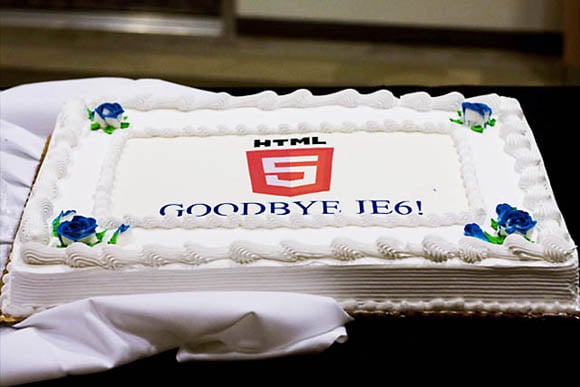
No, you’re not having a strange dream, Microsoft really is celebrating the demise of a flagship product. Continuing the tradition of celebrating milestones in web browser development with cakes, Microsoft’s latest cake marks the “death” of Internet Explorer 6 – or, more accurately, the decline in US IE6 usage to 1%. Microsoft have make a huge effort to get people off Internet Explorer 6 (obviously, they’d rather you went to Internet Explorer 7, 8 or 9 than Firefox, Chrome or Safari, but an effort nonetheless) through hasty development, advertising campaigns, and now even silent updates to upgrade remaining computers. And with Microsoft themselves admitting IE6 has had its day and even the die-hard open sources fans accepting that IE7 onwards is a big improvement, you’d think everyone would be happy.

If, however, you’re reading this blog from a UK government building, you may think you’re accessing news from a parallel universe. The UK public sector is inexplicably at odds with the rest of the world. IE6, like most early browsers, has a sluggish Java engine that runs at snail’s pace on modern Java-Rich pages. Most public web pages have now dropped support for IE6. And yet when the China hacking scandal exposed hugely embarrassing security flaws in IE6, and the French and German governments warned everyone off IE6 (and , for a while, later versions), the Cabinet Office insisted there was nothing to worry about.  To be fair, web browser security isn’t the be-all-and-end-all for government buildings – their strongest defence will always be the safeguards within the Government Secure Internet – but the web browser is the last line of defence in a compromised network, and it’s a reckless to rely on a web browser written before widespread broadband adoption and the security threats it brought along.